
Any woman who survived early coeducation at our Alma Mater, Dartmouth College, has my undying respect, and Gina Barreca not only survived it, she wrote a book about it.
As for how we met, I’m not sure which came first:
- I saw Gina Barreca at the Erma Bombeck Conference website.
- I saw Gina Barreca posting frequently and with enthusiasm in the Women of Dartmouth Facebook group.
- I realized that Gina Barreca was the author of the soon to be reissued, I Used To Be Snow White…But Then I Drifted.
It’s all a social media blur, but in a good way. Once I became familiar with Gina Barreca, I decided to invite her to join the giveaway. She’s exuberant, funny, and fabulous. And from her example, I think any woman writer, writing humorous or not, can find a great model of how to wield irreverent intelligence shrewdly enough to stand out in any crowd.
Introducing Gina Barreca
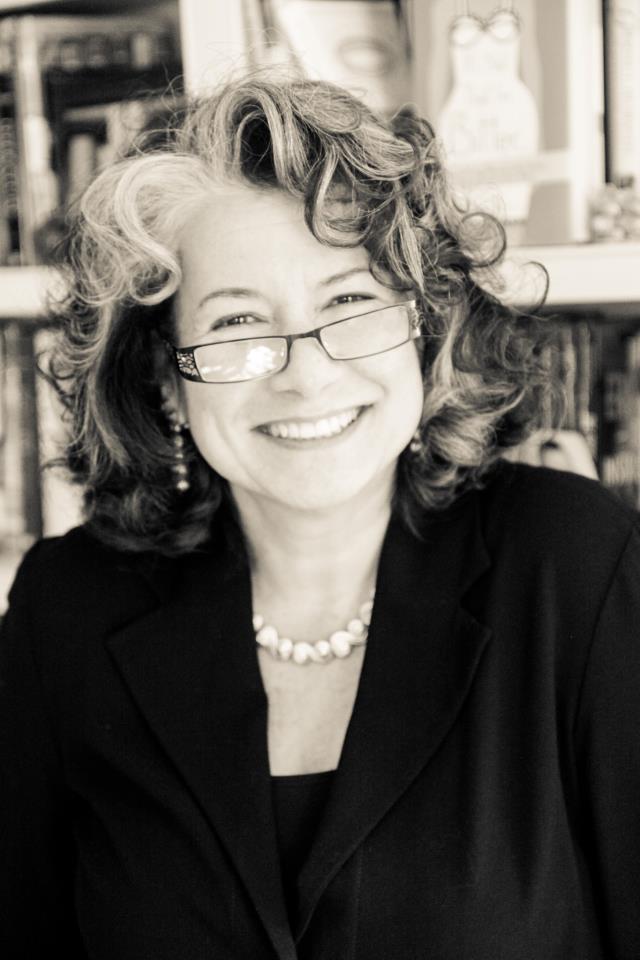 Gina Barreca is most recently the editor of Make Mine A Double: Why Women Like Us Like To Drink (or Not) published by the University Press of New England in 2011 and author of It’s Not That I’m Bitter: How I Learned to Stop Worrying About Visible Panty Lines and Conquered the World (St. Martin’s, 2009). She has appeared on 20/20, The Today Show, CNN, the BBC, NPR, Oprah, and Dr. Phil, to discuss gender, power, politics, and humor.
Her earlier books include the bestselling They Used to Call Me Snow White But I Drifted: Women’s Strategic Use of Humor (which is being reissued in a “classic” edition by UPNE in 2013) and Babes in Boyland: A Personal History of Coeducation in the Ivy League; her books have been translated into several languages, including Chinese, Spanish, Japanese, and German.
Gina, whose columns from the Hartford Courant are distributed worldwide by the McClatchy-Tribune Syndicate, is Professor of English and Feminist Theory at the University of Connecticut. Her B.A. is from Dartmouth College, where she was one of the first classes of women, her M.A. is from an all-women’s college at Cambridge University, and her Ph.D. is from the City University of New York. Gina blogs regularly for Psychology Today, The Chronicle of Higher Education, and The Huffington Post; she has also written for The New York Times, The Independent (of London), Cosmopolitan, The Harvard Business Review, and other newspapers and magazines worldwide. She grew up in Brooklyn, lives with her husband in Connecticut, and has friends all over the place. www.ginabarreca.com
Le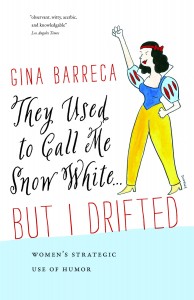 arn about They Used To Call Me Snow White…But I Drifted by
UPNE May 2013
Published by Viking in 1991 and issued as a paperback through Penguin Books in 1992, Snow White became an instant classic for both academic and general audiences interested in how women use humor and what others (men) think about funny women.
Barreca, who draws on the work of scholars, writers, and comedians to illuminate a sharp critique of the gender-specific aspects of humor, provides laughs and provokes arguments as she shows how humor helps women break rules and occupy center stage.
Barreca’s new introduction provides a funny and fierce, up-to-the-minute account of the fate of women’s humor over the past twenty years, mapping what has changed in our culture–and questioning what hasn’t.
I asked Gina three questions about our giveaway’s theme topic, self-expression:
1. Is self-expression an important part of your life today, why or why not?
The stories we tell about ourselves and our lives not only reflect our worlds: they create them. The perspectives we bring to an event or a situation shape its meaning. What will be hysterically funny and light to me, for example, might be something you see as weighty and sentimentally significant. Neither perspective is more correct or accurate because they are both expressions of our individual selves.
I tend to bring the party with me for several reasons, one being that my mother died when I was very young thereby inadvertently teaching me to see the joy and absurdity in every moment of every day whenever possible–but I have friends whose visions of the world have a more shadowed nuance, and who play better after dark than I do and their work is of great value. Every form of expression is self-expression so, yep, it’s important.
2. What does self-expression mean to you and how do you do it in the world?
When I learned that I could speak up, speak out and stop apologizing or feeling embarrassed for telling the truth about my own experiences, emotions, ambitions and needs, I realized I could write the way I always wanted to write: with joy and generosity. I’ve learned to write from the heart as well as from the head; as a scholar and professor, my early training helped me discipline my research and my writing habits but as a writer of humor, memoirs, personal essays and now as a national columnist, I’ve had to change my relationship to the very act of writing. It’s become more of a conversation and less of a lecture.
Only within the last ten years have I come to realize that when I talk about what I’ve always regarded as my deepest eccentricities and weirdnesses, I’m talking about stuff everybody–or at least every woman who is too old for work study and too young for cremation–will understand.
3. How does your self-expression impact the world—your family, your friends, your readers, and everyone else?
I write and I speak; I pretty much do both as much as I can and I know my vocation is to help others do both better, too. I teach at UConn and I give lectures about women’s writing and the importance of women’s humor in venues around the country–and around the world. When 300, or 3000, women in a room start laughing together, we raise the roof and we raise the sense of possibilities in our lives. When we work, speak, and laugh together, we all benefit. The best self-expression embraces others.
And Now, Your Turn…
You remember how this works right?
Please read the complete rules at least once!
I ask you a question.
You answer in the comments for your chance to win a book each day.
Please just respond once, even if you make a typo. 
Answer in the comments in 50-200 words (no less and no more to qualify to win one of today’s books).
What is the funniest thing that has ever happened to you? Maybe it is only funny now, in retrospect. Whether funny then, now or both, you are invited to share a story that tickled you funny.
Ready, set, comment! I will hold the drawing tomorrow and post the results here in my blog.
Thanks for participating in the Writer Mama Every-Day-In-May Book Giveaway!
And thanks for spreading the word. We will be giving away great books by wonderful women authors all month.
View the complete list of authors and books.
View the giveaway Pinterest board.
